


The Revolutionary Schuyler Sisters: Five Questions for Author Amanda Vaill

In digging into the lives of the sisters Hamilton made famous, their acclaimed biographer gives us a fresh take on the role of women in the founding era of our country.
When Amanda Vaill read Ron Chernow’s 2004 biography of Alexander Hamilton, her creative curiosity was piqued — not unlike playwright Lin-Manuel Miranda, who famously used the material as inspiration for his hip-hop narrative of the founding father. Vaill’s interest, though, was in the Schuyler sisters – particularly Angelica and Eliza. “I remember thinking someone should look into these women’s lives,” says the native New Yorker, author, and journalist. “I had no idea I’d be that someone.”
At the time, Vaill was knee-deep in researching a different cast of intriguing characters — Ernest Hemingway and the other correspondents who covered the Spanish Civil War. But a few months after Hotel Florida: Truth, Love and Death in the Spanish Civil War hit bookstore shelves, Vaill found herself in the audience of a new off-Broadway musical at the Public Theater. “Watching that brilliant production, I realized I’d been in love with these women all along,” she says. “I was desperate to claim them.”
The result, Pride and Pleasure: The Schuyler Sisters in an Age of Revolution, is a finalist for the 2025 National Book Critics Circle Award. A former book editor, Vaill has written three other biographies — including Everyone Was So Young, about the glamour and tragedy of Jazz Agers Gerald and Sara Murphy and their 1920s French Riviera set, and Somewhere: The Life of Jerome Robbins — as well as an Emmy-winning screenplay. Her essays and criticism have appeared in The New York Times Book Review, The Washington Post, and Town & Country, among many other publications.
On Tuesday, March 10, Vaill will sit down with journalist Celia McGee as part of the Trinity Talks speaker series. In advance of her visit, she spoke with us about her new book, the sisters who inspired it, and the role of Trinity Church in their lives.
What surprised you most as you looked at the roles Eliza Hamilton and Angelica Church played in the story of the Revolution — or the way their own lives were themselves revolutionary? How does your book shift our understanding of women as active participants in the formation of our country?
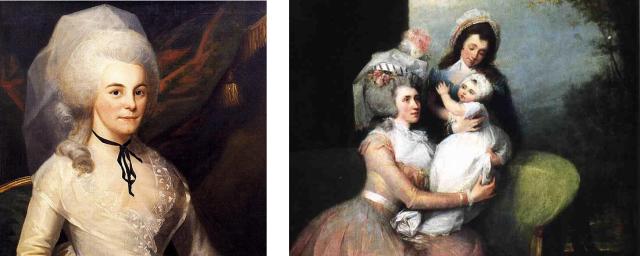
“Surprise” suggests that I began my research with opinions about my subjects — and I try not to do that. I start with questions: who, what, how, why. That said, I was dealing with the opinions of other biographers and historians, who seemed to believe that between the two eldest sisters, Angelica was the witty, pretty, smart one — a brilliant extrovert who hobnobbed or flirted with virtually every prominent man of her time — while Eliza was the boring, dutiful, not-so-smart tradwife who kept Hamilton's household, bore his children, and put up with his peccadillos. The surprise to me was that Angelica, for all her charm and cleverness, turned out to be a somewhat shallow woman who never got what she most desired. Eliza, on the other hand, had a fulfilling life as Hamiton’s not-so-silent partner, despite the crushing tragedies she sustained, and a career as non-profit executive, literary executor, and even political influencer in the years after her husband's death. Also, she was just as funny as her sister.
There’s a temptation in writing about women in this period to make claims for them as “active participants” in historical events in which they’re not the primary actors; and indeed, I did discover incidents where that was true — Angelica's masterminding of a failed plot to free Lafayette from prison during the French Revolution, Eliza's efforts to involve Hamilton in his last major court case, about press freedom and truth as a defense against libel. But the real shift in perspective I hope my book accomplishes is to bring forward the women’s experience of historical events, from the Battle of Saratoga to the establishment and growth of the young republic. And to re-position the men in the relationships and households that formed, sustained, and influenced them — the world made by women.
We know that history is shaped by what is preserved in the archives — and what is tossed aside. You’ve spoken about a second narrative hidden in the stuff of everyday life: household accounts, classified ads, receipts, even domestic objects. What did you learn from excavating these unconventional sources?
I got all kinds of hints and details. The first evidence of enslaved servants in Philip Schuyler’s household, for instance, comes from an invoice for his purchase of multiple sets of what seems like livery for both men and boys. There were far too many pairs of breeches and sets of buttons and cloth for coats than would be needed for himself or his sons, who were still infants. A comparison between a Schuyler food invoice, which lists items like oysters, lobsters, and imported delicacies such as sugar (lots of it) and Madeira, and a Hamilton grocery list, which is heavy on economical staples such as cabbages, turnips, and mutton, shows that Eliza was a much more frugal consumer. An advertisement for Down Place, the Thames-side country house Angelica and her husband John Church bought in England, tells us what the property consisted of. And a beautiful dress Eliza embroidered for her grandchild shows us that she was a fine needlewoman who lavished care on those she loved.
Trinity Church pops up throughout your book almost like a character: a constant backdrop to the sisters’ New York lives and a bookend to your narrative. What do we know about Eliza’s relationship to the church during the Revolution, when Trinity was led by a Loyalist rector? And what does Trinity’s presence say about how your characters — and the founders in general — viewed religion?
Eliza and Hamilton weren’t in New York in wartime, so had no relationship to the Loyalist rector, Charles Inglis; they moved to the city in late November 1783, by which time he’d departed. Although Eliza had been raised in the Dutch Reformed Church, and there was a Reformed parish in the city, she and Hamilton chose to attend Trinity, perhaps because it was the house of worship for prominent members of the government, of whom Hamilton was one. (They worshipped in St. Paul’s Chapel, though, since Trinity itself had been burnt in the Great Fire of 1776.) Five of the Hamilton children were baptized there, beginning in 1788, and Hamilton rented a pew for the family, but seems to have attended services less often than Eliza did. Nonetheless, he contributed money to support a clergyman's salary, served as legal counsel to the church, and voted in 1792 to select an assistant minister, even though he and his family were at that point living in Philadelphia, where the government moved in 1790. Eliza also voted in that election and was a regular communicant (at least from 1801 to 1805, according to records kept by the rector). Her funeral, in 1854, like Hamilton’s in 1804, was held at Trinity and she’s buried in the churchyard — her modest little stone tablet just steps away from Hamilton’s imposing monument. She seems to have had a more orthodox, performative faith than her husband. Hamilton, like Washington, was somewhat uncomfortable with the rituals of the church — not unusual for a man of the Enlightenment who preferred rationalism to mystery. However, Eliza maintained that on the day of Washington's inauguration, both men attended services and took communion.
In a letter to Eliza, Angelica says: “I love your husband very much and if you were as generous as the Old Romans you would lend him to me for a little while.” How do you interpret the complex relationships between the sisters and Alexander Hamilton?
This is one of the great conundrums of the book. Angelica was married with two small children when she first met Hamilton, and from the first they were attracted to one another, despite his very evident love for her sister. They carried on an epistolary flirtation after she moved to London with her husband in 1784 (“I see one great source of happiness snatched away,” Hamilton wrote her when told the relocation was probably permanent; “an ocean is now to separate us”). But during her 6-month visit to New York after Washington's inauguration, that relationship may have changed. For the next seven years their correspondence became highly charged and partially clandestine: Angelica frequently wrote to Hamilton at his office, not at home where her sister would see her letters. She sent him a miniature of herself — the sort of token usually sent to a lover, not a brother-in-law. And when she and her husband returned to New York in 1797, moving in two doors down from the Hamiltons on Broadway, she and Hamilton were regularly seen in one another's company. Her sister, not so much.
Eliza, who adored her sister and missed her dreadfully when they were apart, didn't comment on the situation, not even when her sister presumed to tell her what sort of china Hamilton would prefer, or accused her (without justification) of wanting her husband to leave the government (Angelica wrote, “That so good a wife should be so bad a patriot is wonderful!”). Hamilton seems to have persuaded himself that Eliza approved of his relationship with her sister (going so far as to write, “Betsey ... consents to everything”). However, by 1799, Eliza's temper appears to have grown short; Hamilton's letters to her (when he is traveling) indicate tension in the marriage.
There is no documentary proof that Angelica and Hamilton went farther than flirtation, but evidence suggests it. And although some historians have contended that the Schuyler family's support for Hamilton refutes that, Hamilton’s most ardent letters to Angelica were never seen by anyone (with the exception of a few partial transcriptions made in the late nineteenth century) until the 1960s, which I think undercuts that contention.
You’ve said you like to write about characters during times of change. We’re certainly in one of those moments now! What are the similarities between the “turning point in history” the Schuyler sisters lived through and the shifting ground of the present day?
It’s almost too uncomfortable to think about. The Schuylers lived through eight years of a devastating civil war, in which loyal, enthusiastic British subjects rebelled against what they saw as the increasingly tyrannical behavior of a leader who subjected them to taxes that they had not voted for and sent armed men into their communities to fire on civilian protesters. Sound familiar?
Another similarity between their experience and ours: polarized political debate, or what Washington and Hamilton decried as “faction,” that affects everything from media to medicine. They had The Aurora and the Evening Post; we have Fox News v. MSNBC. During the devastating yellow fever epidemic of 1793, which killed 10 percent of the population of Philadelphia, the city was divided into the followers of the Republican physician Benjamin Rush, who bled and purged patients to drive out “evil humors,” and adherents of “Federalist” medicine, which aimed to build up patients' strength, lessen nausea, and reduce fever. During the 2020 Covid epidemic, the U.S. was split between those who advocated masks, quarantine, and vaccines and those who thought such measures an infringement of their liberties (or thought injecting bleach might do the trick).
Do my subjects offer us a pathway out of this difficulty? I don't know. Hamilton made it through the Revolutionary War unscathed, but he fell victim to political violence. Angelica and Eliza, on the other hand, survived those times — Angelica by deftly changing course to stay on the right side of the prevailing wind, and Eliza by uncharacteristically keeping her mouth shut. Her politics, she said, were “to be of no party, but to respect myself.”
To hear more, please join us for Trinity Talks: The Schuyler Sisters in an Age of Revolution on Tuesday, March 10 at 6pm in St. Paul’s Chapel.
Want to know what’s coming up next? Sign up for our Music & Events newsletter to learn about our upcoming concerts and talks.
This interview has been edited for length and clarity.
More Articles

A Path to Peace: Five Questions for Maya Soetoro

Forgiveness as Resistance: Six Questions for Author Kevin Sack

A Case Against Despair: Six Questions for Author Christian Wiman