So You Think You Know Santa?
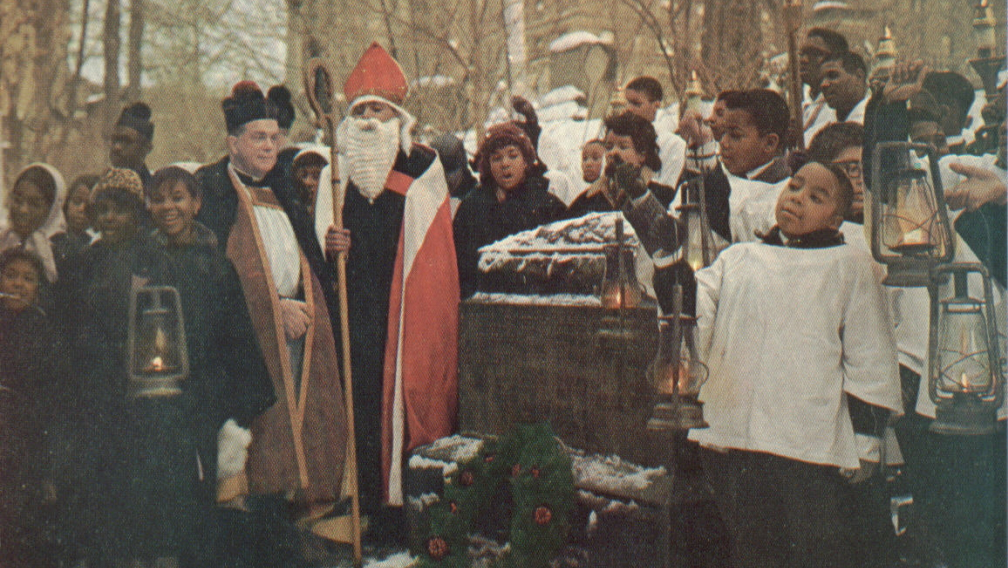
For more than 110 years, a one-time Trinity chapel has hosted a holiday tradition honoring the creator of the modern-day Santa Claus. Marissa Maggs, director of the Trinity Church Archive, explains the connection — and how Alexander Hamilton figures in the story!
In 1823, the United States met Santa. The nice one.
It started with a new Christmas poem, published anonymously in an upstate New York newspaper, The Troy Sentinel, on December 23, 1823. “A Visit from St. Nicholas,” better known as “’Twas the Night Before Christmas,” introduced a kinder, jollier Santa Claus — one who wore a red suit, was known to enter homes through the chimneys, and had a miniature flying sleigh and eight melodically named reindeer (yes, Comet and Cupid and Donder and Blitzen).
The charming story went viral, by the standards of the time, with the new Santa quickly outstripping the stern historical figure of St. Nicholas in popularity. By 1837, the anonymous author stepped forward to reveal himself: He was respected New York writer and scholar Clement Clarke Moore, who’d composed the poem for his six children and hidden his identity because he considered the whimsical verse beneath his dignity. Clement was the son of the Rev. Benjamin Moore, who served as Trinity Church’s sixth rector from 1800–1816. And the Rev. Moore was the second Bishop of New York, best known now for giving Alexander Hamilton his last rites after his fatal duel with Aaron Burr in 1804.
After his death in 1863, Clement Clarke Moore was first interred at the burial ground of St. Luke-in-the-Fields in Greenwich Village, where he had served as the church’s first warden. In 1889, he was relocated to Trinity Church’s Uptown Cemetery in Manhattan’s Washington Heights, where he rests today.
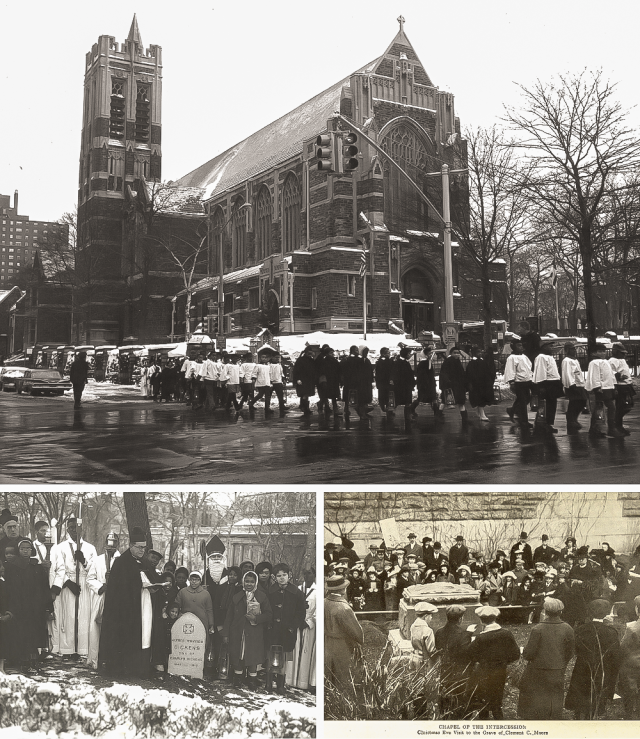
In 1911, the adjacent Church of the Intercession — at the time a Trinity chapel — began hosting a festive reading of “A Visit from St. Nicholas” on Christmas Eve. Initially, the event was an activity for Sunday School pupils, who would then lead a procession of teachers, parents, and choir members from the church to Moore’s gravesite, where they would lay a wreath, conduct a brief prayer service, and sing Christmas carols. For a time, the procession would visit a second stone in the cemetery: that of Alfred Tennyson Dickens, son of Charles Dickens, author of another beloved Christmas tale, A Christmas Carol.
The cherished annual tradition, now open to the public, has continued to grow in popularity since 1911, with such readers as basketball great Isiah Thomas and jazz legend Ron Carter lending their voices to the tale.
Related articles
A Heart Full of Grace: MLK and the Case for Christian Giving
The God Who’s All Around Us

Jesus’s Message for Turbulent Times