





A Heart Full of Grace: MLK and the Case for Christian Giving
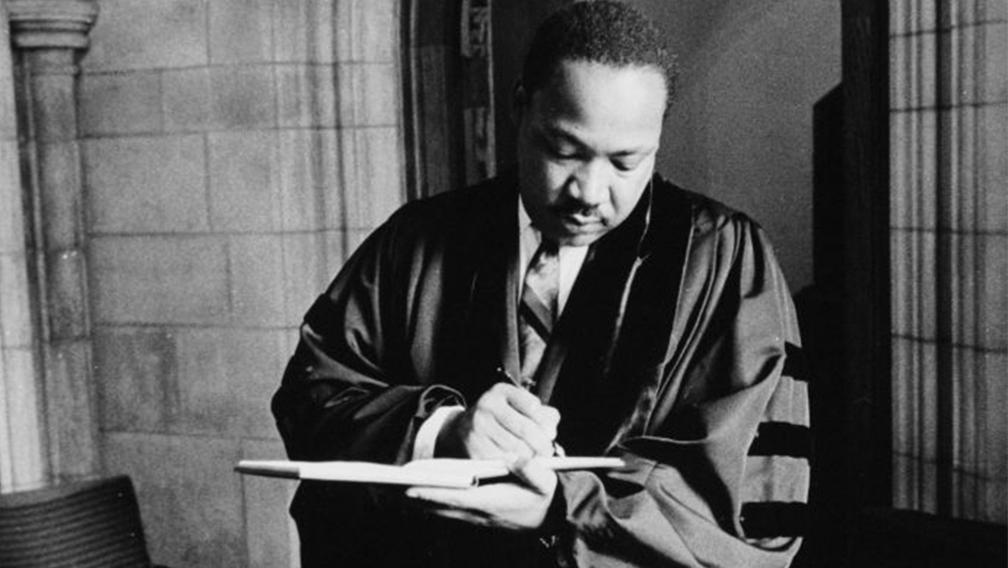
Ahead of his visit to Trinity, the Rev. Canon John Thompson-Quartey of the Diocese of Atlanta reflects on the Rev. Martin Luther King Jr.’s enduring call to sacrificial generosity.
Every January, Trinity Church remembers the life of the Rev. Martin Luther King Jr. in a special Sunday worship service. In the collect, or prayer for the day, we ask God to help us follow King’s example “to resist oppression in the name of [God’s] love.” For King, resistance was expansive, a “radical revolution of values” that inspired real action to dismantle not only racism but also poverty and violence.
In a recent interview, this year’s MLK Sunday guest preacher, the Rev. Canon John Thompson-Quartey, shared insight into King’s ultimate vision — a Beloved Community rooted in justice, peace, and love — and how we might use the resources we have to help make that dream a reality in our own communities today.
Join us for worship on January 18 as we honor the legacy of Martin Luther King Jr. The Rev. Thompson-Quartey preaches at the 11:15am service. At 10am, join the Rev. Thompson-Quartey’s special Discovery session to further explore the connection between giving and justice.
In his letter from Birmingham Jail, the Rev. Martin Luther King Jr. urged his “Fellow Clergymen” to “recapture the sacrificial spirit of the early church” that disturbed the power structures of their day. According to the Book of Acts, that sacrifice was tangible; the earliest Christians shared all they had with one another, distributing their possessions according to the needs in their community. What lessons can we learn from their example?
Two distinctive features stand out to me in the communal life of the early Christian church. First, the economic ecosystem they created benefited the entire community of believers; everyone’s needs were met through the ethic of love and generative abundance. Second, their collective consciousness set them apart. As the Scriptures inform us, “they were all of one heart and mind” (Acts 4:32).
The community described in the Book of Acts held the belief that the return of Jesus Christ was imminent and that their accumulated wealth could not serve them in the coming reign of God. So, it was necessary to rid themselves of their worldly possessions.
We can achieve King’s vision by practicing selfless love and radical forgiveness.”
The Rev. Canon John Thompson-Quartey
The community was marked by deep fellowship and a spirit of generosity, so that no one was destitute. The glue that held them together was their unity around a common purpose, which was to glorify God by loving and caring for one another. They embodied the servant ministry of Jesus. What we can learn from these early Christians is the need for a shared purpose, motivated by love, compassion, and forgiveness.
The greatest commandments, according to Jesus, are to love God and love your neighbor as yourself. Early Christians practiced this love so well that they became the envy of their pagan neighbors, prompting second-century theologian Tertullian to write about how others marveled at Christian mutual love (“‘See, how they love one another’ they say … how they are ready even to die for one another”). Members of the early church proclaimed their faith to the world through acts of lovingkindness, generosity, and a spirit of compassion and forgiveness. We can recapture this spirit by practicing genuine love for everyone and caring for the needs of those among us who are poor. Through this, the world will know us by our love.
King’s idea of Beloved Community — a powerful vision of nonviolence and economic justice “in which all people can share in the wealth of the earth” (The King Center) — was rooted in the concept of agape, which he described as “the love of God operating in the human heart.” How do we make King’s vision a reality and embody agape in our own lives?
In his book Stride Toward Freedom, Dr. King wrote that agape is “understanding, redeeming good will for all men.” To King, agape is loving others for their own sakes and making no distinction between friend and enemy — “seeking to create and preserve community” with a “willingness to sacrifice in the interest of mutuality.” King believed that agape seeks to practice forgiveness.
To embody King’s idea of the Beloved Community, we must work toward the creation of the Beloved Community through acts of genuine, unconditional love. Although the Montgomery bus boycott was an act of nonviolent resistance, King explained to his followers that the ultimate goal of the movement was reconciliation of the community. We can achieve King’s vision by practicing selfless love and radical forgiveness. We must overcome the human instinct to retaliate or seek vengeance in the face of injustice and hostility.
Agape love requires us to treat each other with respect, even when we disagree. In our baptismal covenant in The Episcopal Church, we are asked to respect the dignity of every human being, including those who hate us and treat us with contempt. To make King’s vision a reality, we must first pray for strength to love our enemies and pray for those who mistreat us. I believe that our baptismal covenant commits us to the practice of agape love.
King said, “The true neighbor will risk his position, his prestige, and even his life for the welfare of others.” What role does risk, or cost, play in how we give? Should our giving push against our comfort?
Risk plays a very significant role; I believe that our giving should push us beyond our comfort zone. If we possess an abundance mindset instead of a scarcity mindset, and we give to promote the mission and vision of God, then we are essentially betting on God to provide for our well-being and sustenance.
I am reminded of the story of the widow of Zarephath, who in the midst of a severe drought, demonstrated faith in God’s provision by showing generous hospitality to Elijah, a total stranger. By her actions, she received the resurrection of her dead son and an abundance of flour and oil for her family for many days until the rains came (1 Kings 17:16).
Does Christian giving encompass more than money?
Absolutely! Christian giving must be motivated by our attitude towards God’s generosity. The late Terry Parsons, who served for many years as The Episcopal Church’s Program Officer for Stewardship, once said, “Stewardship is what we do with all that we have and all that we are, after we say ‘We believe’.”
When we offer our gifts of time, talent, and treasure, we are being good stewards of the resources God has blessed us with. In the Rite 1 Eucharist, we pray, “And here we offer and present unto thee, O Lord, ourselves, our souls and bodies, to be a reasonable, holy, and living sacrifice unto thee.”
As Christians, our act of worship is our response to the love of God in Jesus Christ, who came to live among us as a servant. Jesus taught by example, giving himself for the betterment of the needy. As his disciples, we must commit not only our finances, but also our time and talent, in service to others.
In his Drum Major Instinct sermon, Dr. Martin Luther King admonished his audience to use the gifts they’d been given. King said, “Everybody can be great ... because anybody can serve. You don’t have to have a college degree to serve. You don’t have to make your subject and verb agree to serve. You only need a heart full of grace. A soul generated by love.”
Christian giving must be sacrificial and beneficial to others.
The Rev. Canon John Thompson-Quartey has served as Canon for Ministry in the diocese of Atlanta since 2014. He is Professor in the Practice of Church Leadership and Director of the Episcopal and Anglican Studies Program at the Candler School of Theology at Emory University.
Related articles
What Is Ash Wednesday?

Finding God in Every Place and Time

The God Who’s All Around Us