




What Is Ash Wednesday?
Rich in symbolism, Ash Wednesday is more than a noteworthy day on the church calendar — it’s the beginning of a sacred journey we take together.
Ash Wednesday is the start of Lent, the 40-day season in which Christians across the globe prepare to celebrate Jesus’s resurrection on Easter. It’s an ancient practice with roots going back to the sixth century, and its purpose extends far beyond the day itself.
“The rituals of Ash Wednesday don’t stand alone. They are a gateway,” says the Rev. Michael Bird, Trinity’s vicar. “They invite us into a season of repentance — of turning back to God.”
At Trinity, we mark the day with a midweek service prescribed in the Book of Common Prayer.
Ash Wednesday appeared in the first version of the prayer book published in England in 1549, yet it went unnamed beginning with the 1552 revision that followed. It would reappear in the first American edition of the book approved by the newly formed Episcopal Church in 1789. It’s part of our history as a faith community.
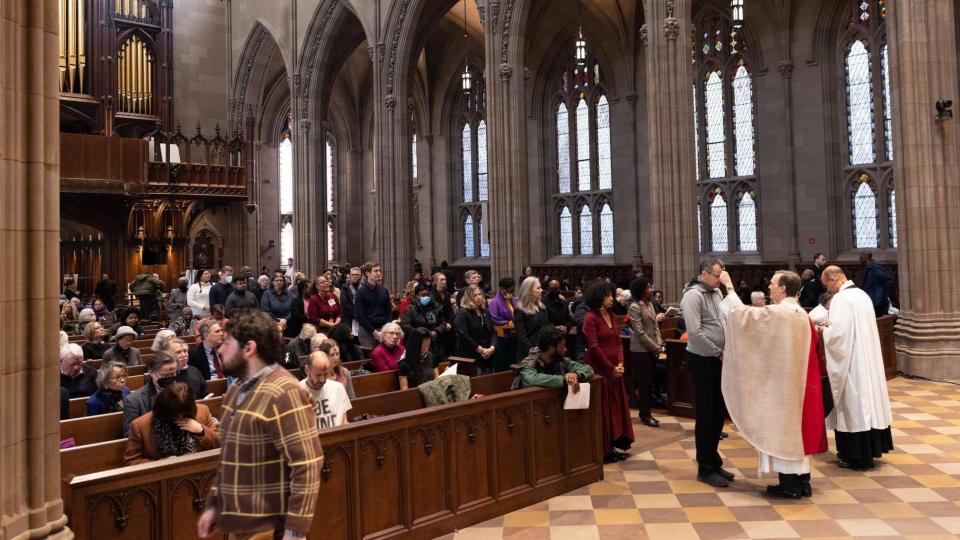
The service is made up of three moments unique to Ash Wednesday: the Invitation to the Observance of a Holy Lent; the Imposition of Ashes; and the Litany of Penitence. We perform these meaningful rituals in community.
“We gather at the start of Lent because the path to Easter is one we walk with one another,” says the Rev. Yein Kim, priest and associate director of Sacramental Life and Membership. “From the beginning, we’re companions. Repentance is a communal act.”
An invitation to recalibrate
It begins with an invitation.
The clergyperson presiding over the service, known as the officiant, stands before the congregation and invites them to “the observance of a holy Lent, by self-examination and repentance; by prayer, fasting, and self-denial; and by reading and meditating on God’s holy Word.”
In the realm of Episcopal worship, it’s a rare moment.
“The liturgy of Ash Wednesday is unique because it’s instructional,” says Mother Yein. “It says exactly what we’re setting out to do over the next 40 days. There’s a clarity to it.”
Reflection and repentance are core to Lenten practice, yet another way to think of the season might be as a time to recalibrate. Despite the solemn nature we ascribe to Lent, the point is not to feel ashamed or even take on a self-improvement project; it’s a time to embrace our lives and make the space to find God in them.
“Ash Wednesday is this moment we decide we’re going to be truthful with ourselves. We’re going to see things as they are, not as we wish they might be, and we’re going to acknowledge our place in it,” says Father Michael. “I find that very helpful. It’s a time to stop and take inventory. We’re humans — we’re mortal and we’re messy.”
An ancient practice of remembering
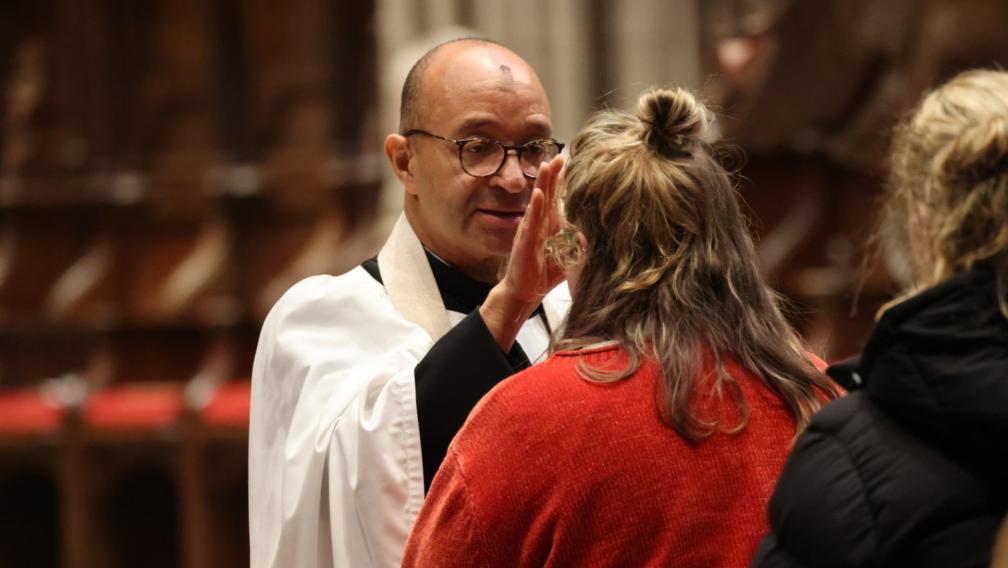
Midway through the service, parishioners are invited to come forward, and a minister uses ash to make the sign of a cross on their foreheads. It’s a direct parallel to the cross we receive during baptism, according to Father Michael, a symbol that we are “sealed by the Holy Spirit in Baptism and marked as Christ’s own for ever.”
As the ashes are imposed, the minister says these words: Remember that you are dust, and to dust you shall return. Though it’s not explicitly in the Bible, the phrase comes from the creation story in Genesis, when God forms humankind from the dust of the earth. It might feel familiar, comforting, a bit terrifying — or perhaps like a mix of different emotions. And that’s alright; there’s space for complexity in Lent.
On Ash Wednesday, and always, we own that we are not perfect; we are dependent on things greater than ourselves. We’re not doing this on our own.”
The Rev. Michael Bird
“The ashes remind us of our mortality — our limits as humans,” says Mother Yein. “They also remind us that God breathed us, and all of creation, into existence. Our lives are a gift, and we’re inherently connected. In a way, with the ashes we’re embodying solidarity with all living things.”
If the practice seems like it’s from another time, that’s because it is. According to The Episcopal Church, the imposition of ashes dates back to the ninth century. But even before that, wearing “sackcloth and ashes” was an ancient symbol of mourning and repentance, one we see throughout the Old Testament.
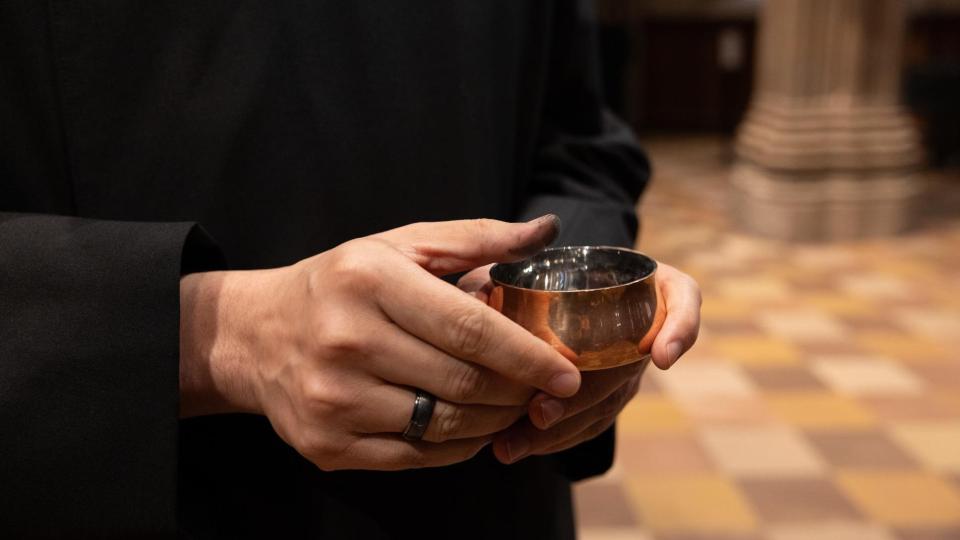
“In Scripture, wearing ashes is an outward sign of something happening on the inside,” says Mother Yein. “It’s like, I have this feeling and I can’t contain it; I need to do something about it. I need to externalize this discomfort. Though we might wear ashes for slightly different reasons today, we’re still grieving. We’re still learning to hold two seemingly contradictory truths at once: death and resurrection.”
The ashes we put on our foreheads are actually the burned leaves from the previous year’s Palm Sunday service. This reminds us of the cyclical nature of our spiritual journey. Though the structure of the church year remains the same, we do not. We are changed.
A prayer leading to reconciliation
Once we’ve received our ashes, it’s time to pray.
Written in a call-and-response format, the Litany of Penitence is pulled together from many prayers across the history of the Anglican church. It begins:
Most holy and merciful Father:
We confess to you and to one another,
and to the whole communion of saints
in heaven and on earth,
that we have sinned by our own fault
in thought, word, and deed;
by what we have done, and by what we have left undone.
As the prayer continues, we name our sins — our hypocrisy, our indifference to injustice, our wastefulness when it comes to natural resources, and other ways we have not aligned our lives with God’s love. Yet the purpose is not to experience shame.
“Claiming our own human frailty is a good thing,” says Father Michael. “On Ash Wednesday, and always, we own that we are not perfect; we are dependent on things greater than ourselves. We’re not doing this on our own.”
As we confess our sins together, we think about how, and what, we’re contributing to the world.
“As we pray, we’re acknowledging all that’s happening in our communities — and our role in it,” says Mother Yein. “Ultimately, it’s liberating. Confession reminds us of our agency.”
In the Christian faith, it’s reconciliation — not confession alone — that’s the destination.
“Self-awareness is not enough,” says Mother Yein. “We must be aware of our sin, and then we must change our behavior. In the Book of Common Prayer, the liturgy for reconciliation includes the phrase, ‘I firmly intend amendment of life.’”
Repentance is freeing. As our awareness grows, we’re able to see how our lives are interconnected, then align our actions with this new understanding — and with God’s deep love for the world.
“Lent reminds us that we’re not stuck,” says Mother Yein, “and we’re not alone. Ash Wednesday shows us, as the Apostle Paul writes to the church in Rome, that we can be transformed. Even when things feel hopeless, there’s light in the darkness.”
Join Trinity Church for Ash Wednesday services on February 18 at 8am, 12:05pm, and 5:30pm. The Rt. Rev. Matthew Heyd, bishop of New York, preaches at 12:05pm.