

Trinity’s Historic Endowment
For over three centuries, careful stewardship has funded Trinity’s support of institutions critical to New York and to The Episcopal Church — and our work continues today.
Highlights
Trinity Church’s original 1705 land grant from Queen Anne has sustained the church’s philanthropic and community support efforts for over 300 years.
Today, the endowment is worth $6 billion. Since 2019, Trinity has provided $502 million in charitable giving, supporting hundreds of nonprofits across New York City, as well as the Episcopal Diocese of New York, The Episcopal Church, and the worldwide Anglican Communion.
Trinity Church employs a professional staff of investment managers and real estate experts to ensure its endowment is responsibly managed to respond to emergencies and continue serving future generations.
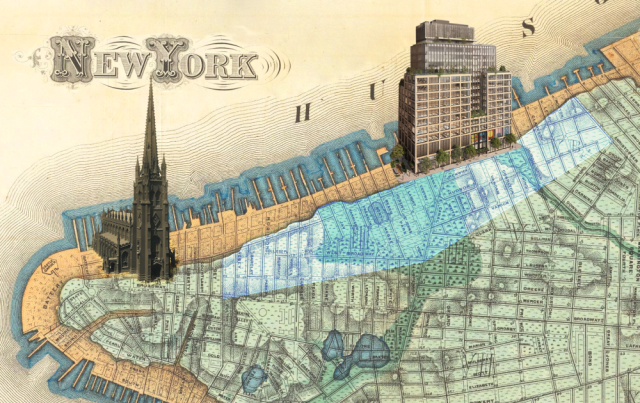
In 1705, Queen Anne of Great Britain granted Trinity Church — then the only Anglican church in New York City — 215 acres of Manhattan, land that stretched up the west side of the island from modern-day Fulton Street to Christopher Street, and from Broadway to the Hudson River.
For over 300 years Trinity has served as a careful steward of that extraordinary gift, and today the grant continues as a $6 billion endowment made up of both real estate holdings and market investments. Since 2019, under the leadership of our rector, the Rev. Phillip A. Jackson, those investments have made possible $502 million in philanthropic giving, direct aid, loans, and investments for our parish, our city, and our global community.
Our use of our endowment to support our community extends across time, from colonial New York to the depths of the Great Depression and into the present day. In Trinity’s early years, the land helped us establish institutions indelibly linked to New York. In 1760, King’s College, now Columbia University, opened on five acres provided by Trinity near what is now City Hall Park. The church also provided property for Trinity Hospital at 50 Varick Street; for Trinity Mission House, the parish outreach center; and for some of the city’s first daycares and kindergartens. Those schools provided a blueprint for the city and for the nation at a time when quality early childhood education was virtually nonexistent.
Trinity was also responsible for providing land and financing the construction for many of the Anglican (and then, post–American Revolution, Episcopal) churches across our city. During the Great Depression, Trinity almost went bankrupt from the costs of supporting Episcopal churches that otherwise would have been forced to shut their doors to those in need. By selling more land from our original grant, the church was able to rebuild its finances over several decades and return to financial stability. During COVID, the church’s care in rebuilding its finances allowed us to provide a $3 million gift to the Episcopal Diocese of New York to support congregations and ministries.
The shape of our endowment has changed dramatically over the last decade. In 2015, Trinity determined that the best way to preserve its endowment for the ages required modernizing a portfolio that was almost exclusively composed of real estate. The resulting land sales and leases helped fund new and more-liquid market investments, all conforming to Trinity’s commitment to advance the Gospel imperatives that we serve our neighbors and all those in need.
This mission-driven investment strategy has amplified our ability to do good at scale, including our work to expand the total stock of affordable housing and to assist other churches in sustainably developing their real estate for long-term stability. Revenue from our investments has funded critical work to address core issues of racial equity and support the youth of our city by funding local schools, supporting over 15,000 local students and their families and running after-school programs that serve an average of 1,000 young people each week.
Our investments also help sustain our community at a time when nonprofits and social service providers are struggling to secure operational funding. We funded more than 130 New York City-based nonprofits through targeted grantmaking in 2025 alone, amounting to over $25 million in support. As a result of that support, 3,300 city households avoided eviction this year and roughly 5,300 young people received support that enabled them to address and prevent homelessness.
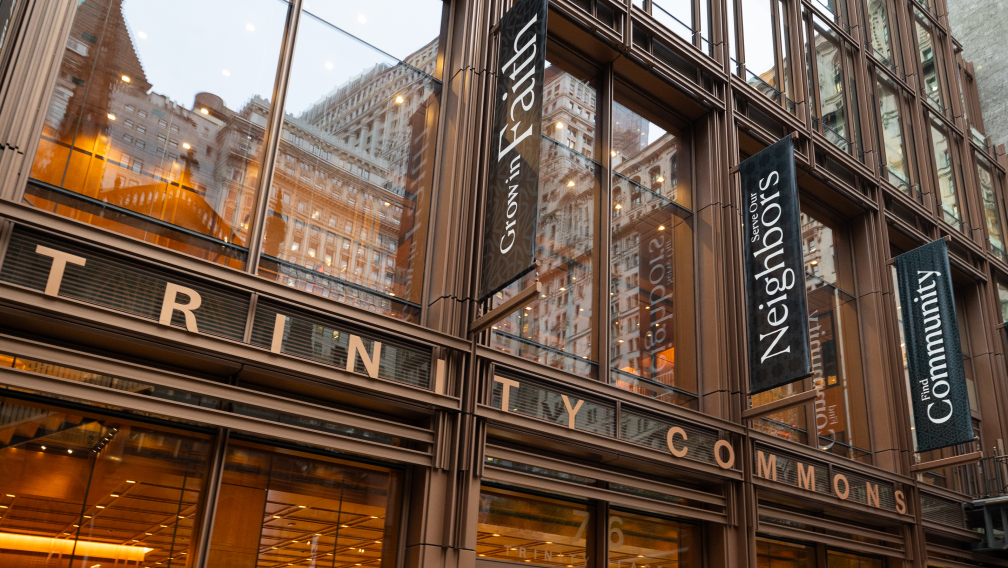
In 2022, it became clear that the arrival of more than 100,000 asylum seekers in New York City required a stronger community response. Since then, Trinity Church has expanded our daily Compassion Meals food assistance program and launched our Compassion Markets, where individuals and families can access free food and household items at our headquarters at Trinity Commons, as well as at a variety of pop-up locations throughout the city. Last year alone, Trinity provided more than 4.7 million healthy meals to our neighbors, and we will continue to feed our community as long as anyone is hungry.
Since 2019, Trinity has also been a leading supporter of churches and Episcopal organizations throughout the world, contributing over $76 million globally. Of that, over $32 million has gone to the Episcopal Diocese of New York in the form of direct and indirect support for individual churches, church ministries, and charitable organizations across the state.
Today, the remaining 15 acres of our real estate portfolio is dedicated to the development of some of the city’s most ambitious new sustainable buildings through Hudson Square Properties, a joint-venture real estate portfolio managed by Trinity Church, Norges Bank Investment Management, and Hines, a global real estate investment manager. Those buildings are more than just industry-leading and award-winning commercial properties; they also serve as a model for the future of adaptive reuse in our city and around the world. The income generated from those properties returns to Trinity to help fund our church operations and our philanthropy.
All these financial gifts are a tremendous responsibility – for Father Phil, who leads all the work of our church, for our vestry, and for the team of exacting professionals who oversee our investing, guide our real estate development, and manage our accounting and financial requirements.
Good financial stewardship means tracing the impact of every single dollar Trinity spends, a fact that is as true today as it was in Queen Anne’s time. Sometimes the deepest impact comes through supporting community organizations already on the ground doing the work. At other times Trinity Church is best positioned to respond to needs directly. No matter the form of our engagement, our goal is always to meet the growing, shifting needs of all New Yorkers, from those whose families have been parishioners at Trinity since the American Revolution to the newest New Yorkers arriving in our city every day.
Living our Christian faith isn’t always easy, but it is simple: We’re here to love God and love our neighbors as we love ourselves. Church at its best is the extension of God’s justice and infinite mercy into our living world. For over 300 years, Trinity has committed itself to serving our community to the fullest in pursuit of that goal. By thoughtfully stewarding our resources with an eye toward long-term impact, we can continue to do so with joyfulness and singleness of heart, for the shared benefit of all.