
A New Way to Learn
In a bold experiment at Church Divinity School of the Pacific, President Stephen Fowl is reshaping seminary education for the next generation of faith leaders.
Since their inception in the 16th century, seminary schools based students at campuses where they ate, studied, and slept shoulder-to-shoulder with their colleagues — grounding their work in their relationships with each other and in sharing faith in cloistered communities.
For Stephen Fowl, PhD, the president of Berkeley’s Church Divinity School of the Pacific (CDSP), a Trinity partner, seminary education is still about fostering a spiritual and educational community. But he’s embarked on a bold new experiment to reshape how students engage with Episcopal religious training in an increasingly digital world — and expanding the notion of community by encouraging attention to the places where students live and practice their calling.
The 132-year-old CDSP seminary is now two years into Fowl’s reinvention. Roughly 60 students from across the United States now attend CDSP’s courses every year, putting to use an all-online approach to coursework that Fowl sees as more collaborative and less constrained by the limitations of physical space. Equally important has been a rethinking about how students can engage in the communities they eventually want to serve.
“One of the biggest things I heard from students is that our old model — a semester schedule followed by an intensive in-person session — left them no time to actually live their work,” reflected Fowl. “In response we’ve made the program more breathable. It lets students focus on one thing at a time.”
Fowl’s decision to move CDSP to a quarterly, online schedule was informed in part by the students’ busy schedules and travel considerations. It was also an acknowledgement, Fowl says, that new students expected seminary programming to be as organized as they were.
“These students have jobs, they’re pursuing other degrees, they have kids, and they work really hard to keep all of that stuff organized.” Fowl said. “We wanted to build a program that gave students stability and flexibility for when life intervened. And the students really appreciate that we’re doing this from a place of respecting the lives they’ve built.”
For CDSP’s faculty, freeing students from classroom-heavy seminary courses creates new opportunities for those students to practice their faith within their home communities. Where more traditional seminaries emphasize developing a standardized understanding of Episcopal doctrine and process, CDSP views students’ individual experiences as fundamental to delivering an authentic Gospel message.
We treat the context our students come from as a gift … [that] can deepen their ability to minister in their communities.”
One of Fowl’s top priorities is breaking down the educational silos that often make seminary education feel disconnected from the living world, starting with how students learn. Traditionally, seminary education provides classroom training and then leaves students to make connections between coursework and a living ministry — even if they aren’t quite sure how to do that.
CDSP staff bridges that gap by modeling the social behaviors that help build new experiences. Classwork often requires students to bring in voices from outside the school, and staff host quarterly gatherings where students can build firsthand experience in the social aspects of seminary education. As Fowl soon discovered, students engaged with the program differently based on their personal backgrounds, a fact often overlooked by classroom-focused programs.
“In some places your personal social context is seen as a kind of barrier to learning, and schools spend a lot of time trying to get everyone into the same headspace,” says Fowl. “We treat the context our students come from as a gift, and we want them to bring that context with them so we can deepen their ability to minister in their communities.”
The school’s rapid transition has been a challenge, Fowl admits, especially given the fact that CDSP is implementing sweeping changes to curriculum in less than half the time it normally takes a traditional seminary — just over a year. Still, faculty already see changes in how students interact with the coursework as a springboard for ministry work outside the campus.
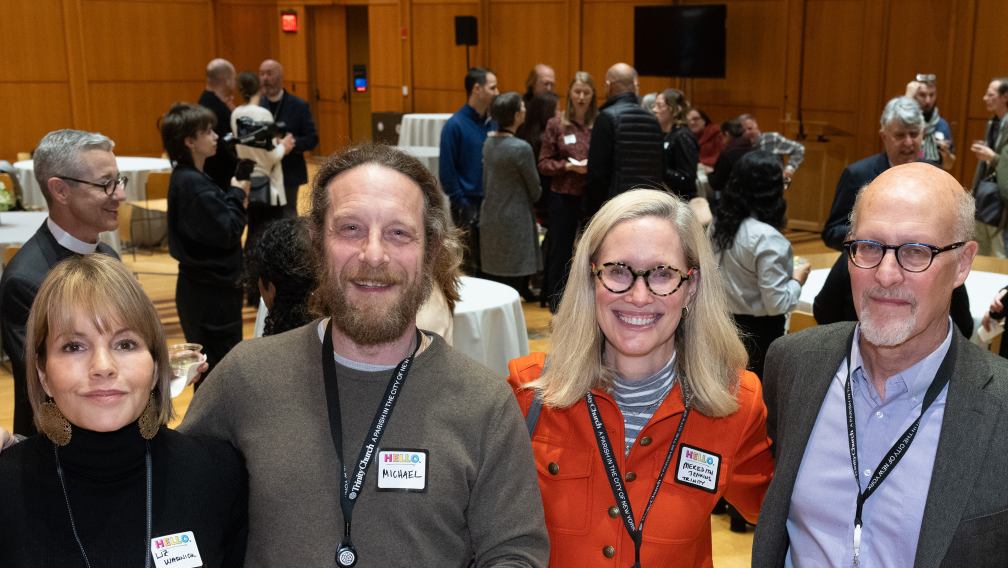
At an in-person reception in early January, Fowl and CDSP faculty got their first real sense of how students would interact with one another and their coursework after spending a full academic year in a remote learning environment. Even Fowl had doubts that the program would fulfill students’ learning and social needs in its first major trial.
Those worries were unwarranted. As students bonded over stories of applying their coursework in their local communities, Fowl realized that keeping students in their social environments actually enhanced the impact of their classroom work.
“Our students realized, oh, this really works,” Fowl said. “We can come together from all over the country and come to a single spot, invest our time and energy in each other and the work, and then go back to our contexts and pick the work we’re doing. That was a huge achievement for our faculty.”
With CDSP’s hybrid teaching model established, school administrators are now focused on strengthening the faculty roster and fine-tuning the new curriculum. The school plans to add two new faculty in the coming academic year in response to growing enrollment. Despite the breakneck pace of change at CDSP, Fowl insists this is only the beginning of a bigger plan to make the school’s programming more relevant to the lived experiences of students.
“Seeing our students embracing these changes and bringing their own ideas to what we can improve is really inspiring,” he said. “We say our students should always be learning, and we’re finding that’s just as true for all of us at CDSP. I couldn’t be happier at what we’ve achieved together.”