



Anna Lapwood Pipes Up!
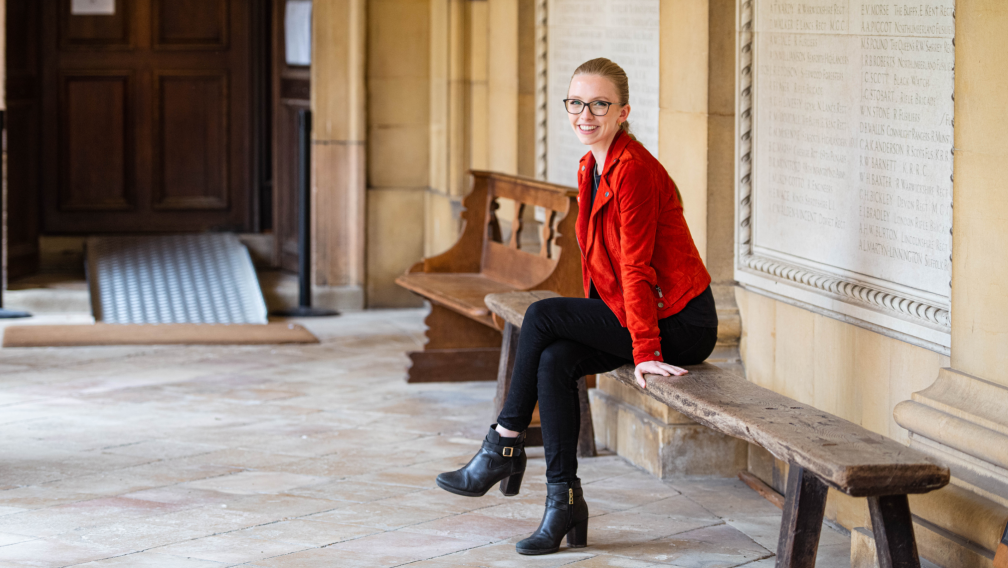
On her way to “meet” Trinity’s landmark new organ, one of classical music’s brightest stars discusses the awe of making (and sharing!) music and what feeds her unfettered joy.
Growing up, Anna Lapwood always thought she hated the pipe organ. Though its music provided a soundtrack to her young life (she’s the daughter of an Anglican clergyman), it held zero interest. “I think I was put off because I didn’t associate the music with a person making it happen,” she says. Instead, beginning in elementary school, Lapwood focused her considerable musical talent on the violin, viola, and harp — to name just a few of the instruments she took up. By 14, after studying at the prestigious Junior Royal Academy, she became the principal harpist of the National Youth Orchestra of Great Britain. Her career path was clear: “I was fixed on becoming a professional harpist and playing in orchestras.”
But then Lapwood joined her church choir. “The organist was right behind where I stood,” she says. And once she got a peek at what an organist could do with those pedals, stops, and keyboards, her career plans took a sharp turn. The first woman in the 560-year history of Magdalen College, Oxford, to be awarded an Organ Scholarship, she was appointed Director of Music at Pembroke College, Cambridge in 2016. There, she directed the chapel choir, founded the Pembroke College Girls' Choir, and oversaw the annual Cambridge Organ Experience for Girls. Recently, after nearly a decade, she left that job to focus on a full-time career as an organist, including her new position as the first-ever official organist of London’s Royal Albert Hall.
Lapwood’s love for harps and orchestras did have a lasting impact, though, fueling a passion for writing transcriptions [the process of converting a musical piece from one format to another]. “I like to approach organ playing with an orchestral brain,” she says. And those days watching the church organist fueled another passion — tearing down the wall between audience and organist. Lapwood has become known for stopping mid-concert to communicate some detail of her instrument or her process.
That enthusiastic engagement mixed with her electric, eclectic virtuosity, has earned Lapwood a devoted social media following of well over three million fans. Her feed is filled with fun mashups, informative videos, and random clips, all of which she narrates with captions often laced with exclamation points and heart emojis. It’s all fodder for a new generation of fans, who may come to hear a favorite movie score — Hans Zimmer’s for Interstellar or her own transcriptions of Pirates of the Caribbean — but leave with an appreciation for Lapwood’s far-ranging classical repertoire.
These days, the 30-year-old has found her world of music expanding even further. From her perch at Royal Albert Hall, she can evangelize for her instrument at an entirely different level — and play a whole new repertoire of music. That includes collaborations with such modern artists as indie rock’s Florence and the Machine and electronica/lounge musician Bonobo.
We had the chance to ask Lapwood about what more she has in store — including an upcoming visit to Trinity to help the church launch its own brand-new pipe organ!
You've said that something you enjoy about your position at Royal Albert Hall is giving people the opportunity to “stumble” upon the organ. What is it like to reach a completely new audience, playing with pop stars like Bonobo and Raye?
It’s completely surreal! It was always a running joke amongst my friends that I grew up under a musical rock, only really listening to classical and film music. I once famously misidentified a song by Justin Timberlake as Beyonce! One of the first non-classical shows I did at the Royal Albert Hall was with Bonobo. I remember sitting there waiting to play; the track before mine had these soaring strings from a full orchestra on the stage, and I had tears running down my face. In that moment, I realized there was a whole other world of incredible music. Now I adore playing for non-classical shows, particularly if nobody in the audience is expecting to hear the organ. There’s something rather cool about an audience cheering — we don’t really get that in classical concerts — and it creates an electric current in the room where everyone is feeding off each other’s energy.
Your delight in playing the organ is infectious! Can you share what it is about playing/performing that brings you so much joy?
There are so many levels! Part of it is the joy of helping people see how versatile the organ is. Part of it comes from the music I play. I’ve been finding my musical voice over the past few years and grown more confident performing work that makes my heart sing. Lastly, I think it’s the sense of community I feel in the room at concerts; I am very lucky to have an incredible fan base, and their warmth and kindness constantly amazes me. Performances can feel a bit like a big party, as if we’ve all known each other for years and I’m sharing music with friends. That gives me the confidence to take risks.
Can you describe a favorite moment?
Something surreal happened just recently that topped the list! I was playing a free concert in Germany at Cologne Cathedral. We were expecting maybe 4,000 people, but 13,000 queued up. There were so many that I did two concerts back-to-back, and we still had to turn away 5,000 people! But there was magic in the building, with people standing in the aisles and sitting on every spare bit of floor, and the moment the music started there was total silence. Feeling the energy of that many people quietly concentrating is a special thing.
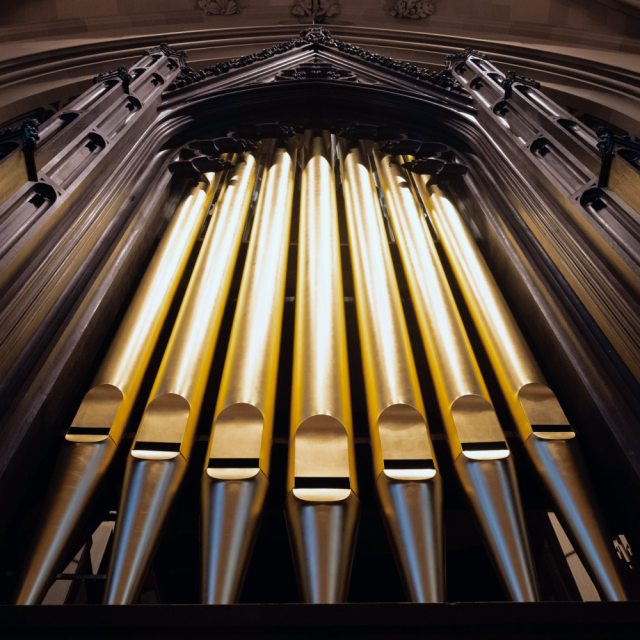
In its most common incarnation, the pipe organ has been a communal and religious instrument, able to inspire feelings of great awe and connection. Can you talk about the instrument's unique quality, and how you manipulate it to move the many diverse audiences you enjoy playing for?
I always think part of the organ’s power of connection is that, like us, it needs to breathe in order to make sound. It’s a sound you can feel resonating through your body, and that seems to bring people a sense of grounding and communion with those around them. I enjoy experimenting with this. Sometimes if I’m playing very softly, I might increase the lower frequencies more than usual, so that people feel the organ before they hear it.
I think the space an organ inhabits is just as important as the instrument itself, though. Whether in a beautiful church with amazing acoustics, or an iconic venue like the Royal Albert Hall, people can almost forget that an organ is anything other than a lovely part of the building — and then the moment it starts to play, it’s like the room comes alive.
Speaking of beautiful buildings, you will be the opener in Trinity’s fall PIPES concert series, a season-long celebration of an instrument ten years in the making. What’s your process when you “meet” a new organ?
It’s always so exciting to meet a new organ! I find the best way to get to know an instrument is to just start registering [choosing the stops that will create the desired sound and texture], and it gradually reveals what makes it sing. So I tend to start registering my program straight away, knowing that by the time I’ve reached the end I will want to revisit the first pieces with all the knowledge I’ve picked up the first time around. Once I’ve done a first pass, I put my iPad out in the building and record bits and pieces, listening back to check how it balances in the room and tweaking registrations accordingly. After I make the essential changes, I repeat this process for the entire program, listening back overnight and noting what still needs adjusting in the morning. Then I spend the last few hours of rehearsal making sure that all the changes are in my muscle memory. It can take 10 hours just to do a first pass, and then another 10 for the rest of the work!
Anna Lapwood performs on September 14 in Trinity Church as part of PIPES: A Season of Celebration. See the full season lineup and reserve your tickets.
This interview has been edited for length and clarity.