


Dignity for Every Voice

Trinity’s groundbreaking Renewal series featured the world premiere of Trans Requiem, a powerful work by composer Andrew Yee that amplifies the beauty, strength, and diversity of the trans experience.
The choir room was still as the first chord sounded — uncertain at first, then gathering strength as each voice entered. It was Trinity Choir's first reading of a brand-new musical commission — Andrew Yee’s Trans Requiem — and something in the energy of the room began to shift as the music filled the space. What started as notes on a page became a vessel: for grief and defiance, for memory and visibility, for the inherent dignity of lives too often erased. In that moment, the artists weren't just rehearsing, they were bearing witness.
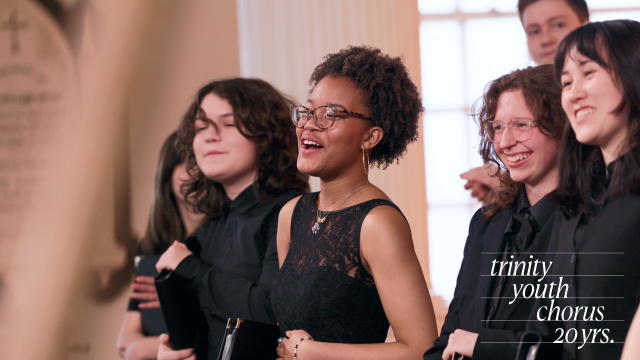
On September 18, Trinity brought this world-premiere work for trans voices, choirs, and orchestra to its community for the first time. Featuring soloists Breanna Sinclairé and Katherine Goforth alongside NOVUS, Trinity Choir, and the Trinity Youth Chorus, Trans Requiem is at once an elegy and an act of resistance, a space to mourn the lost, honor survival, and imagine a future where trans lives are honored and cherished.
Why a Trans Requiem?
Trinity’s long tradition of commissioning bold, socially engaged works is rooted in its mission to serve the spiritual life of New York City and beyond. Trans Requiem is the centerpiece of “Undivided,” the latest concert in the NOVUS Renewal series, which focuses on music as a catalyst for spiritual reflection and social transformation. At a time when members of the trans community continue to face violence and marginalization, Trans Requiem fiercely affirms their sacred worth.
“When we create space to hear even a glimpse of someone's story, we witness how God loves their entire story in all its complexity,” says the Rev. Michael Bird, Trinity's vicar. “In commissioning a piece of music like this, we are saying there is extraordinary beauty everywhere — beauty we are all meant to receive and appreciate.”
Sacred music has always held the power to comfort, but also to transform. In helping bring Trans Requiem to the world, Trinity affirms its role at the intersection of faith, art, and justice. “We stand alongside the most vulnerable and proclaim that every story is worthy of being sung, mourned, and celebrated,” says Director of Music Melissa Attebury.
A New Take on Tradition
Trans Requiem is composer Andrew Yee’s story — a gift to her community, wrapped in love, empathy, and the hope of healing. Rooted in the sacred tradition of the requiem mass, this work reimagines the form through the lens of a trans woman living in a world that too often denies her the right to be fully seen. For Yee, the composition began as an act of mourning — a refusal to rush past sadness in the face of the recent relentless attacks on her community. “I just wanted to be sad,” she recalls. “To take a minute to feel the weight of what was happening to trans people — and to grieve openly. I wanted to give trans folks the dignity of being grieved. We deserve that.”
But the work is more than a requiem for the dead. The Rev. Elizabeth Edman, Episcopal priest, queer theologian, and author of Queer Virtue: What LGBTQ People Know About Life and Love and How It Can Revitalize Christianity, explains: “In Christian tradition, a requiem is always simultaneously an expression of bereavement and of joy: grieving while proclaiming our absolute faith in the power of resurrection. Today, trans people know more than most about the urgent spiritual need to hold both sides of this seeming paradox.”
I wanted to give trans folks the dignity of being grieved. We deserve that.”
Andrew Yee
Yee’s work of living defiance creates a musical space where fear, vulnerability, joy, rage, and peace can coexist. “Each movement reflects something I’ve felt as a trans woman in this world: anger, fear, love, hope. And I wanted to hold them all at once — because that’s how we live,” she says.
The piece follows the broad structure of a traditional requiem, but Yee uses the freedom of the concert setting to shape a deeply personal arc. Following the opening “Kyrie,” the ancient plea for divine mercy, Yee inserts a new movement, “Would You Have Mercy?” that asks mercy not of God, but from harassing strangers on the street. "Lux Aeterna," (or light eternal, traditionally a prayer for the deceased) is preceded by “Light,” a tribute to the late trans activist Cecilia Gentili. Like a fist raised in resistance, “Death Before Detransition” is the work’s most defiant moment, drawing from a poignant poem by J Jennifer Espinoza. Raw and uncompromising, it uses, as Yee explains, “the language of those who hate us, turned inside out. It’s a middle finger wrapped in poetry.”
Yee breaks tradition by reassigning the requiem’s final section, “In Paradisum,” not to soprano voices but to lower ones, reclaiming the closing blessing for those whose voices — and lives — have so often been excluded from grace. In her version, heaven is not reserved for the pure or the “palatable”; it is open to all exactly as they are. “I think those of us with lower voices deserve paradise, too. I don’t need to change myself to be worthy of it,” she says.
A Call to Wholeness
For the trans singers featured in Trans Requiem, performing this work is more than musical interpretation — it’s a sacred act of solidarity. “My identity as a trans individual is just one aspect of who I am,” says soloist Breanna Sinclairé. “I am also a musician, a singer, a leader, and more.” Too often, she notes, people fixate only on the most visible part of a trans person’s identity. But through this music she says, “We are contributing to something revolutionary — something that fosters greater understanding and awareness of our community.”
Bringing a work like Trans Requiem into a sacred space carries profound meaning; many churches have been complicit in the marginalization of trans people. But as Father Bird notes, “Here, in Trinity’s sanctuary, music becomes a bridge — a reclamation of the sacred as a place of welcome, affirmation, and communal mourning.”
It also offers a way for all people to understand their faith more deeply. “Showcasing a liturgical work that is rooted in trans experience can deepen everyone’s understanding of what a requiem is — and will be a living, breathing demonstration of how such an ancient tradition can sustain us now,” says Rev. Edman.
At its heart, Trans Requiem is a call to wholeness — not only for trans people but for all. It serves as a reminder that no one is meant to grieve alone. That beauty and sorrow, resilience and tenderness, can live side by side. That every person is made perfectly in God’s image and deserves to be seen, mourned, celebrated — just as they are.
In this music, we are invited into a collective act of renewal. To listen deeply. To witness. To begin again, together.
Melissa Baker is Trinity’s director, artistic planning.