What Is Palm Sunday?
Amid fronds, fanfare, and palpable tension, this exhilarating yearly observance — the gateway to Holy Week — invites us to walk with Jesus on a deeply human, and unexpected, journey.
Palm Sunday is the first church service of Holy Week, the breathtaking conclusion of Lent. What started on Ash Wednesday ends with a series of liturgies connected by a central narrative. “In Holy Week,” says the Rev. Michael Bird, Trinity’s vicar, “we tell the dramatic story of Jesus’s last days on earth, in word, action, and music.”
Our earliest records of Palm Sunday, or any Holy Week observance, come from the travel writings of fourth-century nun Egeria, a remarkable traveler and early Christian convert from northwest Spain. On a pilgrimage to Jerusalem, she documented worship practices from the formative years of the church, describing a jubilant procession with participants waving palm branches, the basis of the ritual we still practice today.
A victorious entrance
The service begins with the Liturgy of the Palms, when we commemorate Jesus’s arrival in Jerusalem near the end of his ministry. It’s a significant part of the story because he’s entering a place where religious and political power is concentrated. Jerusalem, the home of the temple that was central to Jewish life, was a wealthy city under imperial occupation. The atmosphere would’ve been electric — packed with pilgrims on their Passover journey and Roman troops sent to quash potential uprisings. For those awaiting the prophesized Messiah, it was a moment brimming with expectation.
“For the disciples walking alongside Jesus, and the crowd of pilgrims who cheered for him along the way, Jesus’s joyful entry into Jerusalem likely signified the culmination of their hopes and dreams,” says Kathy Bozzuti-Jones, associate director, Faith Formation and Education. “For centuries, they’d been waiting for the Messiah, the king who would deliver them from oppression and usher in a new political future for their people.”
In Jesus, God came to us as human to the bone. Which means human enough to experience doubt, despair, and betrayal.
The Rev. Michael Bird
That’s where the palms come in. According to the Gospels, Jesus was met with shouts of praise (“Blessed is the one who comes in the name of the Lord — the King of Israel!”) and a path that had been covered in palm branches, an ancient symbol of victory. The writer of John’s Gospel notes that the crowd gathered specifically because they’d witnessed Jesus’s final miracle: raising his friend Lazarus from the dead.
As we walk into the service carrying our own branches, we’re putting ourselves in the position of those who welcomed Jesus, acknowledging our own expectations of how God might move in our world.
“Let these branches be for us signs of [Jesus’s] victory,” says the priest during the Blessing of the Palms, “and grant that we who bear them in his name may ever hail him as our King, and follow him in the way that leads to eternal life.” The words surface a tension inherent to the Christian story; we’ll soon discover Jesus isn’t the kind of king the crowds had in mind.
The story turns
Palm Sunday is a liturgy defined by transition — from Lent to Holy Week, and from hope to despair. Though we start with Jesus’s celebrated arrival in Jerusalem, the story continues.
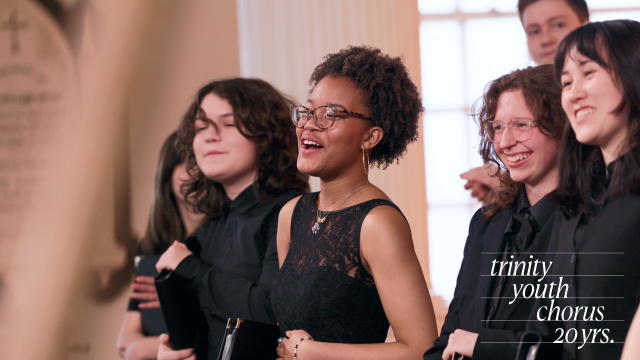
In the portion of the service dedicated to the Gospel, we hear the Passion narrative, an account of Jesus’s arrest, conviction, and death on the cross. The passage, more expansive than what we typically encounter, is presented with flourish. At Trinity, it’s interpreted in a dramatic reading by the Youth Group at one service and chanted improvisationally by the choir in another (this year at 9am and 11am, respectively). And there’s participation throughout — the congregation stands, kneels, and holds a moment of silence.
In essence, we’re walking through the story we’ll explore in full during our Holy Week services over the following days. By noticing that one day a crowd was cheering for Jesus and, not long after, another was demanding his execution, we acknowledge the complexity of our own humanity.
“Palm Sunday is also Passion Sunday — in part, at least, to remember the paradox of being human,” says Bozzuti-Jones. “We long for God, and we joyfully welcome God into our hearts. And then we reject and alienate ourselves from the same God. The desire to connect and the impulse to resist coexist within us.”
An unexpected ending
The stunning end of the Passion, Jesus’s death on the cross, is not the triumph we — or the crowds in Jerusalem — were expecting. It turns out the ultimate expression of love is not a military victory by force or even a distant miracle from on high, but God entering history as a living, breathing person — and laying down his life for his friends.
“In Jesus, God came to us as human to the bone. Which means human enough to experience doubt, despair, and betrayal,” says Father Michael. “In the most heart-wrenching week of Jesus’s life, we see all the ways he subverts our understanding of power — and what it means to be human. When there was the opportunity to hate, Jesus chooses to love. When there was the opportunity to divide, he chose unity. When faced with suffering, Jesus chose to share healing and reach out to others.”
On the cross, Jesus looks head-on at the violence of our world and refuses to respond with more violence. As Christians, we know this isn’t the last word of the story, but it’s where we pause for now.
The service concludes with Prayers over the People, which appears only on Palm Sunday. It’s a collection of the dismissal blessings the congregation has heard throughout Lent, this time sung by the choir, one after the other. On this day, there is no closing hymn or postlude; the people leave in silence.
“There is such pain in Holy Week,” says Father Michael. “And if we have the courage to embrace our heartbreak and open ourselves to the reality of what’s going on around us, we will not be defeated but, together, we will be liberated. This is the story of a God who is willing to experience hopelessness so that we might have hope — of a love so powerful, it will overcome the grave.”
Worship with Trinity Church on Palm Sunday, March 29, at 8am, 9am, 11am, or 1pm. And join a special Compline by Candlelight at 7pm. See the Holy Week schedule.


