



The True Story of the First Performance of “Messiah” in the Western Hemisphere

From the Archives of Trinity Church
It’s a great and oft-repeated story: Trinity Church gave the first performance of Handel’s Messiah in the Americas. Too bad it’s not true. Luckily, the real story is even more interesting.
- The North American premiere of Messiah did happen on Broadway, but not at Trinity Church.
- The first performance of Messiah was given by former Trinity clerk William Tuckey as a benefit for himself in January 1770.
- Trinity Church gave its first Messiah performance in October 1770, offering selections from the oratorio. Today, the historic annual performance of Messiah is a cherished New York tradition.
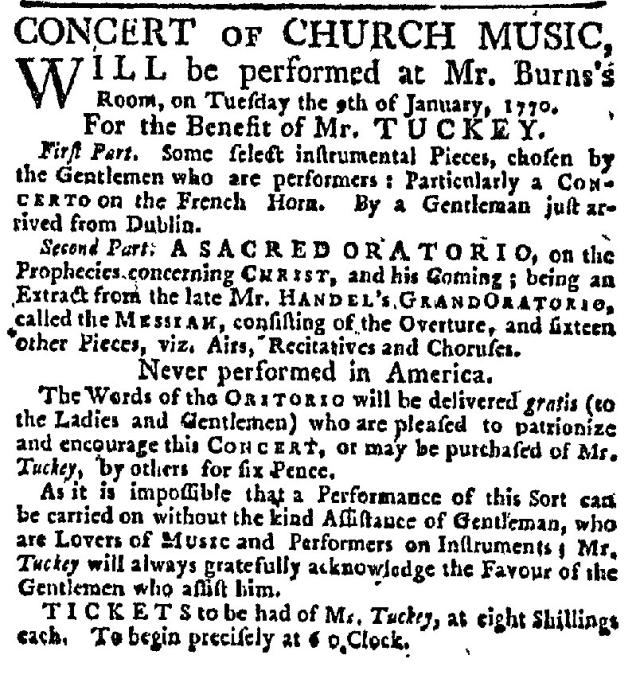
The first performance of Messiah in the Americas was given by William Tuckey, a bankrupt former employee of Trinity Church, as a benefit for himself on Tuesday, January 16, 1770. The concert was held at Mr. Burns Rooms, also known as Burns Coffee-House, a tavern at 9 Broadway. Tuckey actually advertised his performance as the first in America. Admission was 8 shillings.
Here's the original advertisement in The New-York Journal, January 4, 1770:
From the Archives of Trinity Church
The concert was originally scheduled for Tuesday, January 9, 1770, but postponed for one week because there were “a considerable number of Ladies and Gentlemen engag’d for the 9th, which Mr. Tuckey flatters himself will honor him with their Company.”
Tuckey, who came to the colonies from England in 1752, had been vicar choral of the Cathedral Church of Bristol and clerk of St. Mary Port, also in Bristol. He was hired as clerk by Trinity Church in 1753 at a salary of 25 pounds a year. His wife and children then joined him in the colonies. Tuckey’s tasks, besides teaching choir, were to set out the music for the service and lead the singing of psalms. In November 1756, Tuckey was fired from his clerk position for “refusing to officiate in time of Divine Service.” (It is unclear what the Vestry meant by that.)
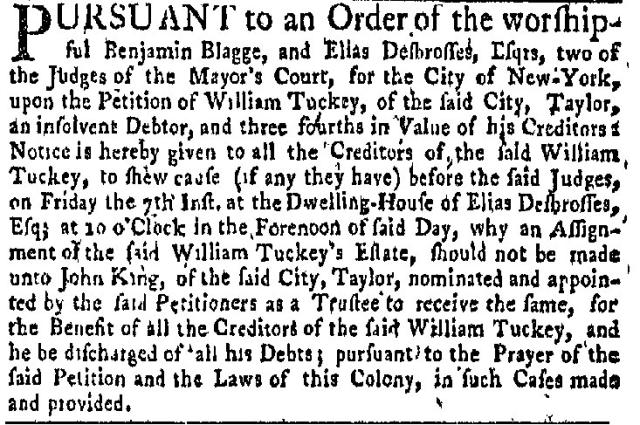
After his dismissal, Tuckey was occasionally paid for preparing special occasion music, including music for the first service at St. Paul’s Chapel. He seems to have continued organizing choirs as well. But by 1769, he was an “insolvent debtor,” according to a newspaper advertisement that requested his creditors to appear before a judge to seek restitution.
From The New-York Gazette and Weekly Mercury, April 3, 1769:
From the Archives of Trinity Church
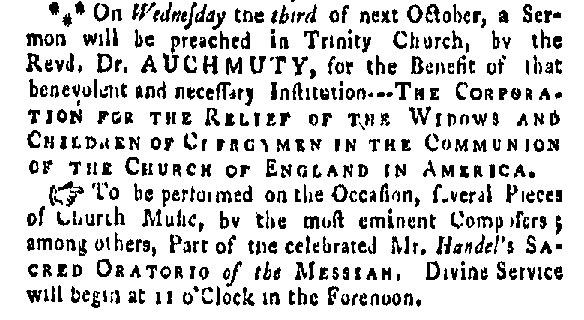
On October 3, 1770, eight-and-a-half months after Messiah’s American premiere in a tavern, Trinity Church gave a performance of selections from the oratorio as part of a benefit for the Corporation for the Relief of the Widows and Children of Clergymen of the Communion of the Church of England in America.
Announcement of the benefit in The New-York Gazette and Weekly Mercury, September 24, 1770:
From the Archives of Trinity Church
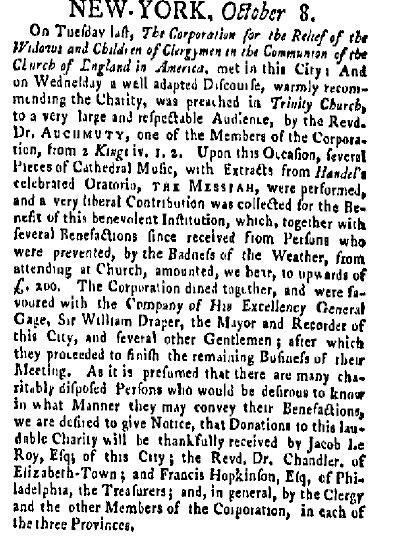
The performance was well received.
Notice from The New-York Journal, October 4, 1770:
From the Archives of Trinity Church
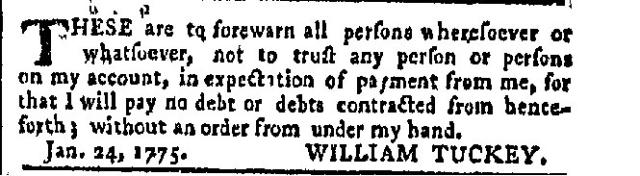
As for Tuckey, he remained active in the New York City music community, publishing church music and giving concerts. But his money troubles never disappeared. In 1775, he had this advertisement printed in city newspapers.
From The New-York Gazette and Weekly Mercury, January 30, 1775:
From the Archives of Trinity Church