



Steve Reich to Sandbox Percussion: A Musical Lineage

In Legacy of Steve Reich, Trinity's new ensemble-in-residence pays tribute to the groundbreaking composer whose work launched a genre
As Sandbox Percussion plays, the textured music — from marimbas, glockenspiels, bongos, and more — reverberates throughout the room. The percussion-forward work is at times spare, at others lush and layered, but it is never anything less than thrilling. And it might not exist today if not for the legendary composer Steve Reich, who turns 90 in October and is the centerpiece of a five-concert series at Trinity this fall.
Reich, who has been hailed by the New Yorker as “the most original musical thinker of our time,” has produced work that can sound simple, but it is anything but. In fact, Sandbox Percussion’s Ian Rosenbaum credits Reich’s pioneering minimalism — classical music that relies on steady pulses, simple repeating patterns, and gradual and subtle changes over time — with laying a foundation for the rhythmically intricate contemporary classical music being composed today. “Reich took percussion to an art form. He made the idea of a percussion chamber ensemble as legitimate as a string quartet or a piano trio or a wind quintet,” says Rosenbaum. “He’s a big part of the reason we exist.”
Sandbox Percussion: Contemporary Collaborators
Sandbox Percussion was officially born in Brooklyn in 2011, when Rosenbaum, along with Jonny Allen, Victor Caccese, and Terry Sweeney, fresh out of music school, set out to stretch the boundaries of the percussive form and champion composers who did the same. They figured that as percussion’s role in classical music grew, so too would the need for percussionists. And they were right. Today, the quartet not only plays with traditional symphonies, but also collaborates with a range of performers and on commission work from young artists, all in the service of amplifying contemporary composers. Along the way, the musicians have built their reputation around visually arresting performances that feature traditional instruments, such as concert snare drums, marimbas, and vibraphones, alongside handmade instruments and everyday objects in a style of play that has been described in the New York Times as “lush” and “exhilarating.”
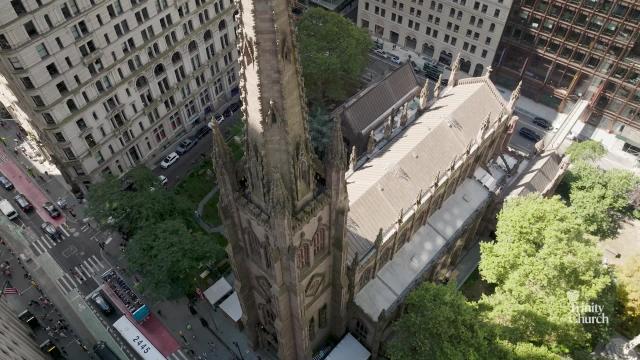
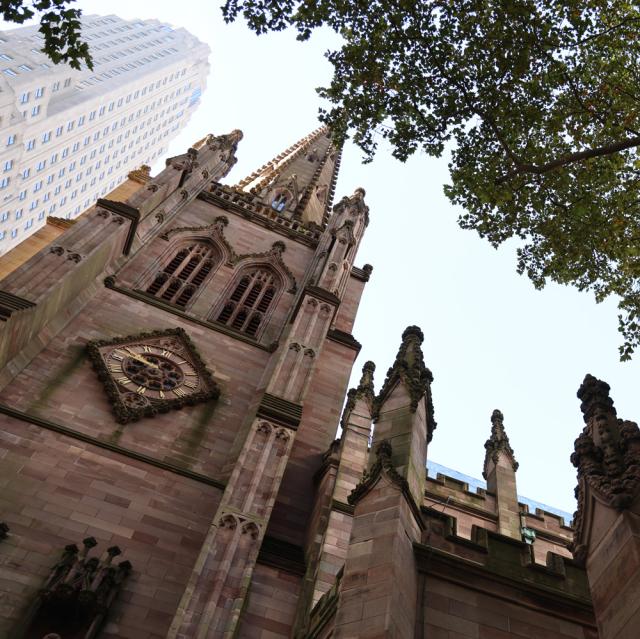
Throughout the years, the Sandbox quartet has also forged strong ties with Trinity. “They’ve become deeply ingrained in the Trinity artist family, the principal percussionists we turn to when we are planning something innovative or big,” says Melissa Baker, Trinity Director of Artistic Planning. This year, Trinity formalized the partnership, inviting Sandbox to be the church's first ensemble-in-residence for a fall season in which the church is celebrating the contemporary classical artists. Their role includes helping to plan and play Legacy of Steve Reich, a series that illustrates how the composer’s work has forever changed both secular and classical music, in which Sandbox will perform alongside Trinity Choir and new-music ensemble NOVUS, with Music Director Melissa Attebury conducting.
Each concert will explore one aspect of Reich’s transcendent body of work, with pieces by Johann Sebastian Bach and several contemporary composers. The real-time dialogue between music that influenced Reich and the music he influenced will give audiences the rare opportunity to hear how deeply his techniques have become embedded in today's compositions.
One Reich song on the program is the era-defining Tehillim, a 1981 work that exemplifies the composer’s reimagining of rhythmic and spiritual vocabularies. Reich set the piece to a Psalm in the original Hebrew, rather than the Latin used by Bach and other composers of sacred music, leaning on its natural cadence to find a unique rhythmic structure. “It’s a sound that encourages you to not analyze,” says Rosenbaum. “It’s almost impossible not to be lulled into a trance — which can be dangerous for those of us who need to be precise while performing it!”
Watch Legacy of Steve Reich: Tehillim at Trinity Church
September 23, 2026
Sandbox, playing alongside Trinity’s musicians, will also take on works by newer composers that push the boundaries of contemporary chamber and symphonic music in their own ways and pair them with foundational Reich pieces. We Are All Travelers presents Sandbox performing Reich’s 16-minute meditative piece Traveler’s Prayer, which once again uses Hebrew texts to explore the journey of human mortality, along with works by Caroline Shaw, Michi Wiancko, and David Lang. And in Transcendence, Sandbox will pair Reich’s Jacob’s Ladder with Portal, a percussive work by steel drummer and Pulitzer finalist — and longtime Sandbox collaborator — Andy Akiho.
The full breadth and depth of Reich’s long-life oeuvre will be celebrated in a very special Reich-only evening with a concert to mark his 90th birthday. “After all these years, Reich is still evolving and composing. It’s extraordinary,” says Rosenbaum. The evening’s lineup will showcase that journey, progressing from the prolific artist’s Tehillim through Proverb (1995), Traveler’s Prayer (2020), and Jacob’s Ladder (2023).
Drumming: Sandbox and Trinity Take on a Rarely Heard Masterpiece
To close out the Legacy of Steve Reich series, Sandbox and the Trinity musicians will deliver the four-part Drumming — the apex of Reich’s experimentation with his game-changing discovery of phasing. A compositional process Reich says he came upon by accident while looping tapes of voices in the 1960s, phasing, which is now used by classical and popular musicians alike, occurs when two or more identical repeating patterns begin in unison, then slowly slip out of and back into sync with one another, generating their own surprising patterns, rhythms, and melodies. The 75-minute piece is amazingly melodic, with bongos tuned to different pitches and the warm wooden tone of marimbas, glockenspiels, and more. Two vocalists and a piccolo have small but impactful jobs — doubling the percussion instruments and emphasizing that melody — and the church itself has its own role to play: “The acoustic of this space shapes the music, like another performer,” says Rosenbaum.
Written in the 1970s, Drumming “changed the world of music,” says Rosenbaum, who has taken this opportunity to teach the technically difficult composition to students from the Mannes School of Music and the Peabody Conservatory who will join the Trinity performance. “Because it can be played by any number of percussionists, it allows us to fold students in.” To Rosenbaum, this is the best way to pass on the skills that have become essential for modern percussionists. ‘’There is a score for Drumming, of course, but it's almost more confusing to look at it that way. It makes more sense to teach by explaining, showing, playing.”
It's a lesson he learned through experience. “None of us were around when Drumming was being written, but an older group of performers explained and taught us, gave us context,” explains Rosenbaum, adding that the magic happens by being in the room together. “This music, this composer — it’s important that the next generation of percussionists knows where we all came from. We want to pass that lineage in whatever way we can."
Hear Sandbox Percussion and Trinity musicians in Legacy of Steve Reich, a five-concert series celebrating the pioneering composer’s influence this fall. Get your free tickets.
More Articles

What Is Evensong?

Five Questions for Composer Steve Reich
