




Five Questions for Messiah Guest Conductor Nicholas McGegan

Photo credit: Dario Acosta.
The Handel expert makes his Trinity debut leading this year’s Messiah
The first time that Nicholas McGegan heard George Frideric Handel’s Messiah he was playing it. “When I was 14 and second chair flute in my town’s amateur orchestra, we performed this elaborate version that was popular in the United Kingdom back then,” he says. “It had all these added wind parts, written by other composers.” And while McGegan says he “had great fun with it,” playing a flute part written by Mozart, he didn’t truly fall for the piece until after college, when he played Messiah in its entirety and as Handel intended it — stripped of the embellishments (including his flute part), with a smaller ensemble of singers and musicians on historic instruments and at a quicker tempo. That was during a performance at Westminster Abbey, where McGegan moved to harpsichord so he could play the original score. “There was so much more energy in it, so much beauty in the simplicity.”
Now, McGegan is on the podium as one of the world’s leading Baroque music experts and a renowned guest conductor. Since first conducting Messiah in 1986, he has led nearly 200 performances, including at London’s Royal Albert Hall with a chorus of 300 voices to commemorate the 250th anniversary of the composer’s death; in Jerusalem, where, of course, the story takes place; and in Dublin on Good Friday, in the city where Handel himself premiered the piece. But while some performances may be more memorable than others, McGegan considers every one of them special. “Where you’re doing it and whom you’re doing it with is always different, and that makes it exciting and tremendously fun,” he says.
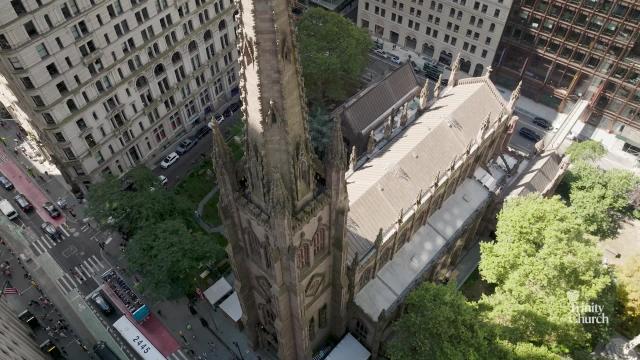
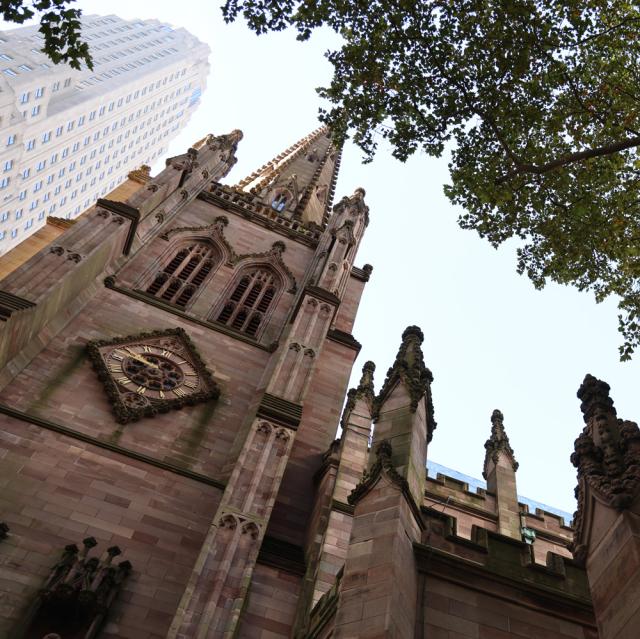
This year, McGegan leads the Trinity Baroque Orchestra and Trinity Choir in performing the full Messiah in Trinity Church, which has its own storied history with the classic work. Trinity first presented selections from Messiah in 1770 in what was one of the earliest performances of the work in North America. Today, it’s an annual Christmas tradition so beloved that tickets sell out within days and livestream viewers tune in from as far away as Australia. We asked McGegan for his thoughts on the holiday masterpiece, its composer, and how he continues to find joy in each performance.
Beethoven, who famously called Handel “the greatest composer that ever lived,” cited his ability “to achieve vast effects with simple means.” What should we listen for in this original score that makes it so emotionally powerful?
It’s interesting to consider what it means that Handel wrote Messiah for Easter — he never thought of it as a Christmas piece. He always performed it close to Passion Week, just before Easter, which put the emphasis firmly on the middle section and Christ’s crucifixion, passion, and eventual resurrection.
Handel was above all setting a religious text, telling a familiar and beloved story of Jesus’s life. He treated that story as if it was at the heart of everything. And if you really listen, you’ll notice that you can always understand the words. As a man of the theater, even when he was writing something sacred, Handel understood drama too. Instead of covering the words in music, he elicited emotion by writing the music to respond to the words. In the best performances, every singer, whether a soloist or a chorus member, is committed first and foremost to getting that story across to the audience.
Beyond it being a masterful piece of music, why do you think Messiah still has the power to captivate, almost 300 years after it was written?
Partly it’s because audiences know this story, whether they’ve heard Messiah or not, and walk in with this built-in expectation — there’s something wonderful about that. They’re anticipating the sacred drama to come, and that comes with its own atmosphere, with this energy that has nothing to do with me or the performers but that’s passed to us by the sense of occasion and the audience. No matter how many times I’ve conducted Messiah, it never feels the same. And that’s part of the joy!
You clearly delight in conducting this piece. How do you approach directing Messiah, and what makes it feel fresh after nearly 200 performances?
I’m always aware that I’m the one responsible for creating that sense of occasion for people. Even if Messiah has been performed hundreds of times, for somebody in that audience, it might be their first time. It’s my job to make sure every performance is memorable. It’s a thrilling responsibility!
As for keeping it fresh, every one of these talented performers brings something different and special. Even if it’s an orchestra I’ve worked with before, the soloists will be different. Some of the singers I work with now weren’t even born the first time I conducted Messiah! They will have their own take and bring something new, which excites and inspires me — I might suddenly have an idea to bring out a particular word or phrase. You never just put a performance in the microwave and have it come out exactly the same. You can’t clone it.
I’ve also had some wonderful experiences with audiences. Once, a choir of women from an African American congregation asked if they could dance at the back of the auditorium. They came in wearing their brightest colors and wonderful hats and just boogied to Messiah. They simply felt free enough to do it. It was all such fun, and even though it was a dress rehearsal, it inspired us to give a better performance. All those moments stay with you.
As a renowned expert on all things Handel, what do you think one can learn about the composer from his beautiful composition?
That he was a good businessman. This music exists because Handel saw a commercial opportunity during Lent, when pretty much everything fun was banned. In the four weeks leading up to Easter, people weren’t supposed to eat meat, and they weren’t supposed to go to the opera. Since there was a theater going begging, an orchestra that otherwise had very little to do, and an audience that would love to hear something, he came up with the very clever idea of presenting sacred but nonstaged works — so technically not opera — in the theater during those weeks before Easter. Everyone was happy (except maybe the Bishop of London, who was an incredible prude!). Handel did all these oratorios at Covent Garden, and the audience, which had nothing else to do, loved them. They were sacred, they were in English, they were dramatic, and many of them, like Messiah, were masterpieces. It was a win-win situation.
Handel was also practical in the way he composed. He would first write what you might call a sketch, going from the beginning to the end without filling in all the parts. The initial sketch of Messiah took him about three weeks. He would write the chorus parts, the voice parts, the bass part, and probably bits of the violin part. It was like a painter making a sketch for a large canvas. But he would hold off on finishing an aria until he knew which soloists would be available. Then he would tailor the aria to that particular singer. It was essentially aria haute couture.
He developed this technique from writing opera. A singer might receive an aria in a basic form and come back saying, “Too long, too short, too high, too low, not fancy enough.” Handel would tweak it, and then once everything was settled, he would go back to the score and fill in the instrumental parts. He wasn’t writing music in a vacuum. If he heard that a fantastic trumpeter was going to be there, he might stick in another trumpet solo. He made it work very precisely for that performance. He was always thinking about the people who were going to perform and the particular occasion for which it was being performed.
What are you most looking forward to while conducting at Trinity, with a Baroque choir and orchestra that plays period instruments?
I’ve certainly done Messiah in New York before, but this is my first in New York that’s at a church and on period instruments. I’m particularly looking forward to performing in a sacred space, which I don’t get to do often enough. These days, many of the Messiahs I conduct are with modern symphony orchestras in much larger halls, such as the New York Philharmonic at Lincoln Center and the Chicago Symphony. Those are 2,000-seat halls, and you need those modern instruments to fill that kind of space. Period-instrument groups are usually a little smaller and quieter, and have a very sprightly, dancing quality — made for a more intimate space. They are especially beautiful to hear in a sacred space that has the kind of acoustics that Trinity does.
I’m also very much looking forward to working with Trinity’s talented soloists. When I’m conducting a symphony orchestra, they’ll normally hire four soloists, usually from out of town, who essentially fly in, sing, and leave — rather like the conductor does. But at Trinity I’ll have the luxury of working with the soloists privately beforehand. I also happen to know quite a few of the musicians, some from my time at Juilliard and who are professors there now. Making music with people you already know has advantages. When working with musicians you haven’t met, you must first establish a trust that already exists with those you’ve played with. It’s like going to a dinner party. If you know some of the guests, you can relax a little bit. At the same time, you also know you will meet wonderful new people at the table and the food is never the same!
Watch the livestream of this year's Messiah on December 4 at 7pm.
This interview has been edited for clarity and length.